In today’s complex financial landscape with so many variables, assumptions, and unknowns, it’s easy to overwhelm your clients with how you prepare and present your recommendations.
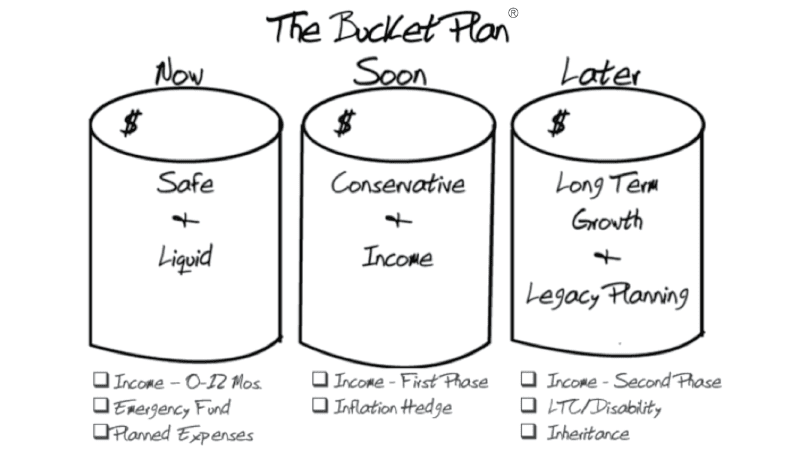
This is where The Bucket Plan® comes into play, offering a straightforward approach to financial planning that’s easy to understand and replicate.
At its core, The Bucket Plan® utilizes ‘The Rule of 3,’ a principle that simplifies complex information into three primary categories.
In this case, it breaks down a client’s financial life into three manageable buckets: Now, Soon, and Later.
This segmentation helps clients easily visualize and comprehend their financial strategy, helping to ensure they are actively engaged and informed about their planning process.
Designing Your Client’s Bucket Plan
Here’s how financial advisors can leverage The Bucket Plan® to streamline their planning processes and better serve their clients.
The Now Bucket: Immediate Financial Needs
Covering Short-term Goals
The Now bucket addresses immediate liquidity needs for the next year. It’s designed to cover income gaps, emergency or comfort funds, and any planned large expenses.
Tailored specifically for clients who are retired or will retire within the next 12 months, this bucket ensures that there is sufficient liquidity to cover short-term needs without compromising long-term growth.
The Soon Bucket: Securing the Next Decade
Bridging the Inflation-adjusted Income Gap
Focusing on the next 10+ years, the Soon bucket aims to bridge the inflation-adjusted income gap. This bucket employs various strategies — drawdowns, lifetime income, portfolio income, or non-income accumulation—based on individual client needs.
The Soon bucket ensures that your clients’ desired lifestyle can be maintained through their early years of retirement, adjusting for inflation, and changing circumstances.
The Later Bucket: Long-term Goals and Growth
Focusing on Future Aspirations
The remainder of a client’s assets falls into the Later bucket, concentrating on long-term growth, lifetime income planning for more than 10+ years into the future, healthcare or confinement needs, and inheritance planning.
This bucket is essential for clients looking to achieve long-term financial goals, allowing for more aggressive investment strategies due to its extended time horizon.
Tailoring The Bucket Plan® to Individual Needs
Customization is Key
The beauty of The Bucket Plan® lies in its adaptability. Financial advisors can tailor each bucket to the specific needs, goals, and situations of their clients.
Through real-world examples and case studies, advisors can illustrate the plan’s flexibility and the critical importance of customizing the strategy to match each client’s unique financial landscape.
Consider the following example of a married couple, both 65 years old, who just retired with an income gap of $25k/year.
To address a $25,000 annual income gap, we set aside an emergency fund and income for the first year in their Now bucket and draw down $25,000 yearly from qualified assets in the Soon Bucket for 10 years to cover the gap while minimizing tax impact.
Their Later bucket holds the remaining assets for long-term growth and tax-efficient inheritance, complemented by an asset-based long-term care policy to avoid financial burden on their children.
This is just one example of how this comprehensive approach to retirement income planning effectively addresses this client’s unique needs and considerations.
Simplify Financial Planning with The Bucket Plan®
A Consultative Approach
This approach fosters a consultative environment where you can offer personalized advice without overwhelming your clients with complexities.
By simplifying financial planning with The Bucket Plan®, advisors can help their clients navigate their financial journey with confidence and clarity.
Incorporating The Bucket Plan® into Your Practice
Adopting The Bucket Plan® in your financial advisory practice can revolutionize the way you approach financial planning and the value you offer to your clients.
It offers a structured yet flexible framework that can accommodate a wide range of client scenarios. Plus, it enhances the advisor-client communication by simplifying complex concepts into a visible strategy.
Embrace Simplicity and Clarity
The Bucket Plan® is more than just a financial planning tool; it’s a way to demystify the planning process for clients, ensuring they are engaged, informed, and confident about their financial future.
For financial advisors looking to simplify their planning process, The Bucket Plan® provides a proven framework to deliver comprehensive, personalized financial advice.
If you’re ready to offer your clients a clear path to achieving their financial goals, we encourage you to explore The Bucket Plan® resources and training opportunities Prosperity Capital Advisors has to offer.
The information provided in this presentation is not intended as investment advice or legal advice. The information provided is for informational and training purposes only. The information in this presentation was accurate as of the time the material was created. Tax laws and rulings can frequently change. Please discuss the client’s current situation with an accountant or tax advisor.